
We are surrounded by places. We walk over and through them. We live in places, relate to others in them, die in them. Nothing we do is unplaced. How...
About Me

We are surrounded by places. We walk over and through them. We live in places, relate to others in them, die in them. Nothing we do is unplaced. How could it be otherwise?
Over the past month, I have been preparing two very different spaces for the arrival of fall. I have been outside preparing my garden for the seasonal change, while also preparing myself to go back to classroom teaching. As I alternated between thinking about what I might plant in the free space on the side of my house and designing my lesson plans for the start of the school year, I realized that these two activities are remarkably similar.
The more I considered the parallels between gardening and teaching, the more I realized all that native gardening has to teach me about education.
When I first started gardening with native plants, I thought the important part was choosing the right plants. Over time, however, I learned that successful native gardening is less about selecting plants from an approved list and more about understanding the ecological system in which those plants will grow. What is the soil like? How much sun reaches this particular spot? What grew here historically? What insects and animals depend on these plants? What relationships already exist, and what might happen if I disrupt them?
In other words, I stopped thinking about native gardening as planting native plants and started thinking about it as ecologically responsive cultivation. As I prepare to return to the classroom, I find myself wondering whether we should think about Place-Based Education (PBE) in much the same way.
My Foray into Native Gardening
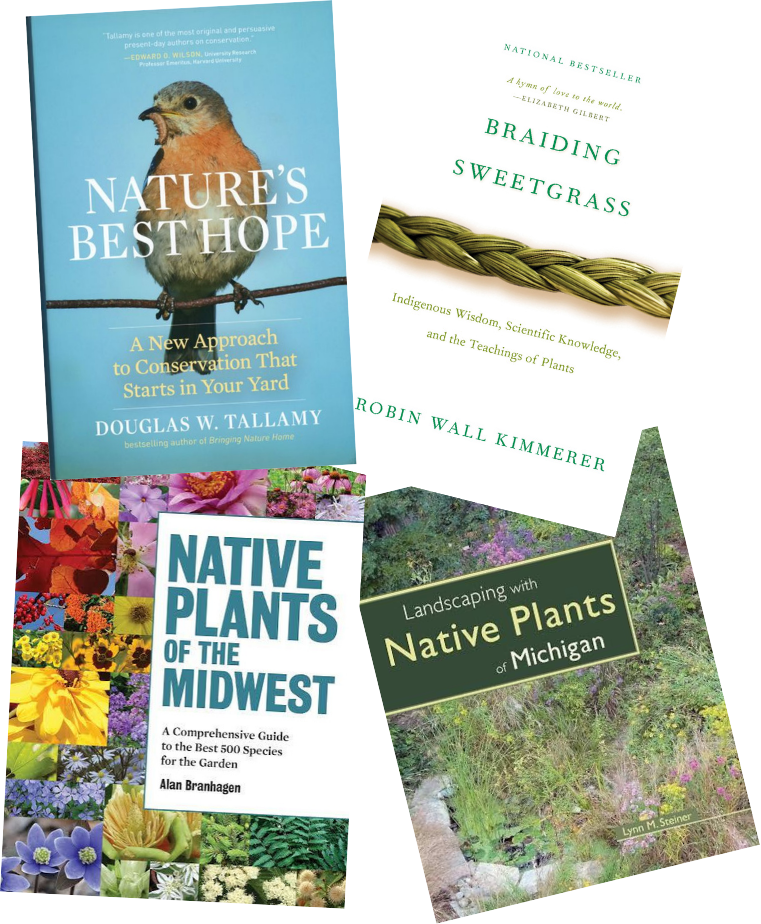
Over the past two years, I have become an amateur native gardener. When I moved to Michigan, I was amazed by the beautiful pollinator gardens and native plant lawns around my community and decided I wanted my yard to look like theirs. I started by reading a couple of books recommended to me by my local Wild Ones chapter—Doug Tallamy’s Nature’s Best Hope and Robin Wall Kimmerer’s Braiding Sweetgrass—then proceeded to borrow books about Michigan’s native plants from my local library.
When I started out, I figured native gardening would be a breeze. After all, if the plants were native to the area, wouldn’t they just take hold and take over when I stuck them in the ground? My Phlox paniculata quickly taught me otherwise. I planted it in the shade of my maple tree, where it promptly died. After about 30 seconds of internet searching, I discovered the obvious thing I had failed to consider: just because a plant is native to Michigan does not mean it will grow anywhere in Michigan. I hadn’t considered whether the soil, moisture, and sunlight in that particular corner of my yard were appropriate for what I had planted.
So I started learning about my place.
I discovered that my backyard has sandy soil while my front yard has clay, in part because my community sits on the site of an old continental glacier that receded to form a lake bed. I learned that the surrounding land had once been a dense swamp system and forest with seasonal marshes. I learned that this land was home to the Anishinaabe Three Fires Confederacy—the Ojibwe, Odawa, and Potawatomi peoples—and I began learning about their cultural practices and perspectives as well.
As I learned more about the place I was inhabiting, I became more thoughtful about what I put into it.
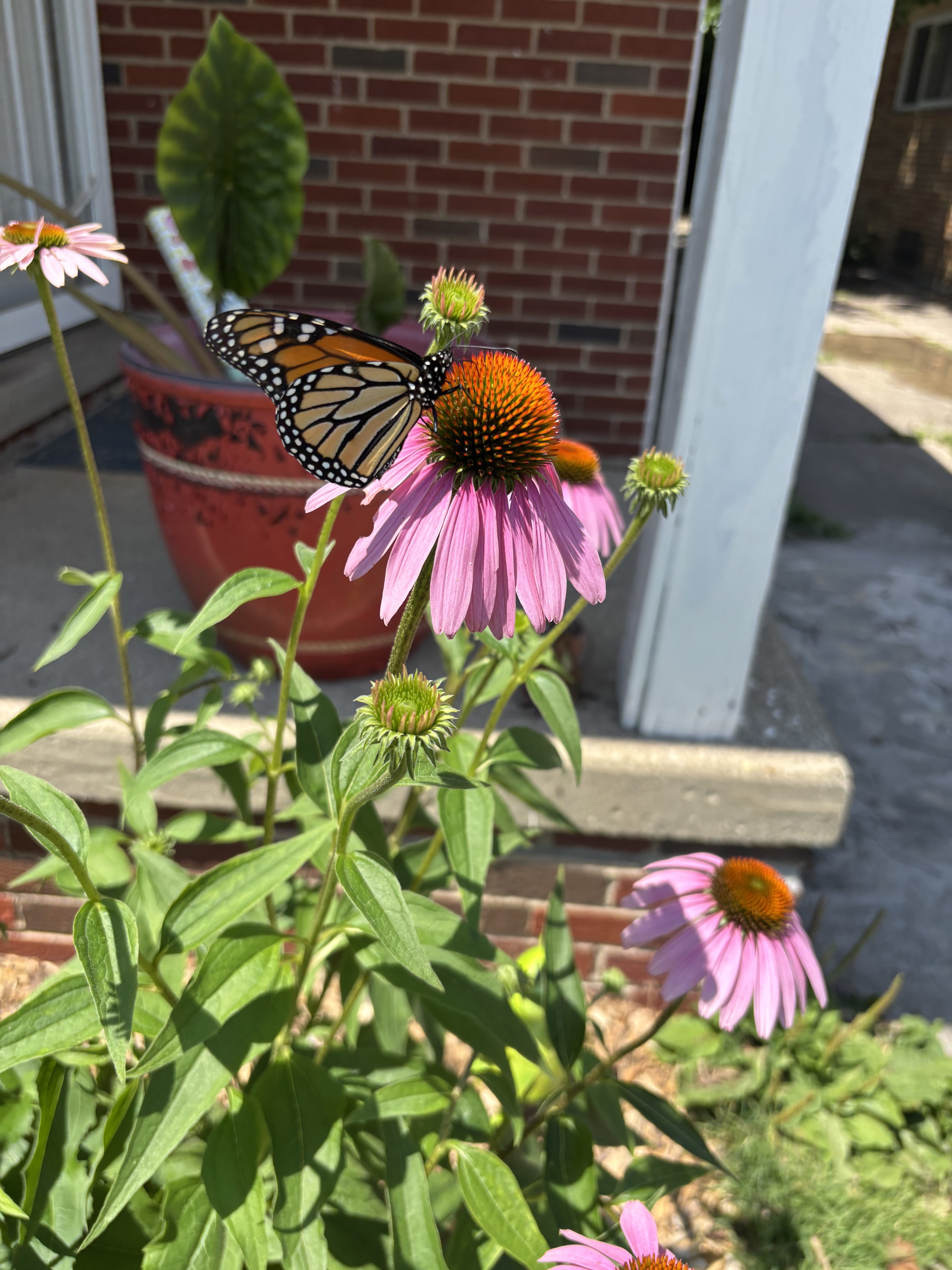
Slowly, I collected plants suited to the actual conditions of my yard. Those plants thrived. And then something wonderful happened: other things began showing up. In particular, my favorite insect–bees! Along with a wealth of bees and other insects and animals, the diversity of life in my yard increased dramatically. My disappointment over the dead phlox was replaced by the joy of watching biodiversity return to a space that had previously been largely monoculture.
Somewhere along the way, I realized I wasn’t really trying to make a pollinator garden anymore. I was trying to cultivate a healthy ecosystem. That realization has fundamentally changed the way I think about education.
Education Happens in Ecosystems, Too
Ecological Systems Theory gives us a useful way to think about why place matters in education. Bronfenbrenner (1979), and later Bronfenbrenner and Morris (2006), argued that human development emerges through continuous interactions between individuals and the multiple environments surrounding them. Learning and development, in other words, cannot be understood solely in terms of what is happening inside a learner. Relationships, institutions, culture, resources, and historical changes all matter.
Place-Based Education (PBE) starts from a similar premise. PBE uses local environments, communities, cultures, histories, and real-world issues as contexts for learning. Instead of treating academic knowledge as something detached from students’ lives, students investigate the places they inhabit and use disciplinary knowledge to better understand—and potentially improve—those places (Alsbury et al., 2020; Gruenewald, 2003; Yemini et al., 2025). It is closely related to culturally relevant and responsive pedagogies because it asks teachers to take seriously the cultural and experiential knowledge students bring into the classroom.
This is where my garden keeps coming back to me. An ecosystem isn’t a collection of independent organisms. Soil, plants, animals, weather, water, climate, microorganisms, and countless other elements continuously interact. Change one part and other parts respond. Communities work similarly.
So, what if we imagine a community as an ecosystem?
Cultural Knowledge Is the Soil
Let’s start underground. Soil can look deceptively simple. We walk on it, dig holes in it, and complain when it gets tracked through the house. But soil is a remarkably complex mixture of minerals, organic matter, water, air, microorganisms, and accumulated ecological history. The composition of soil determines what can grow.
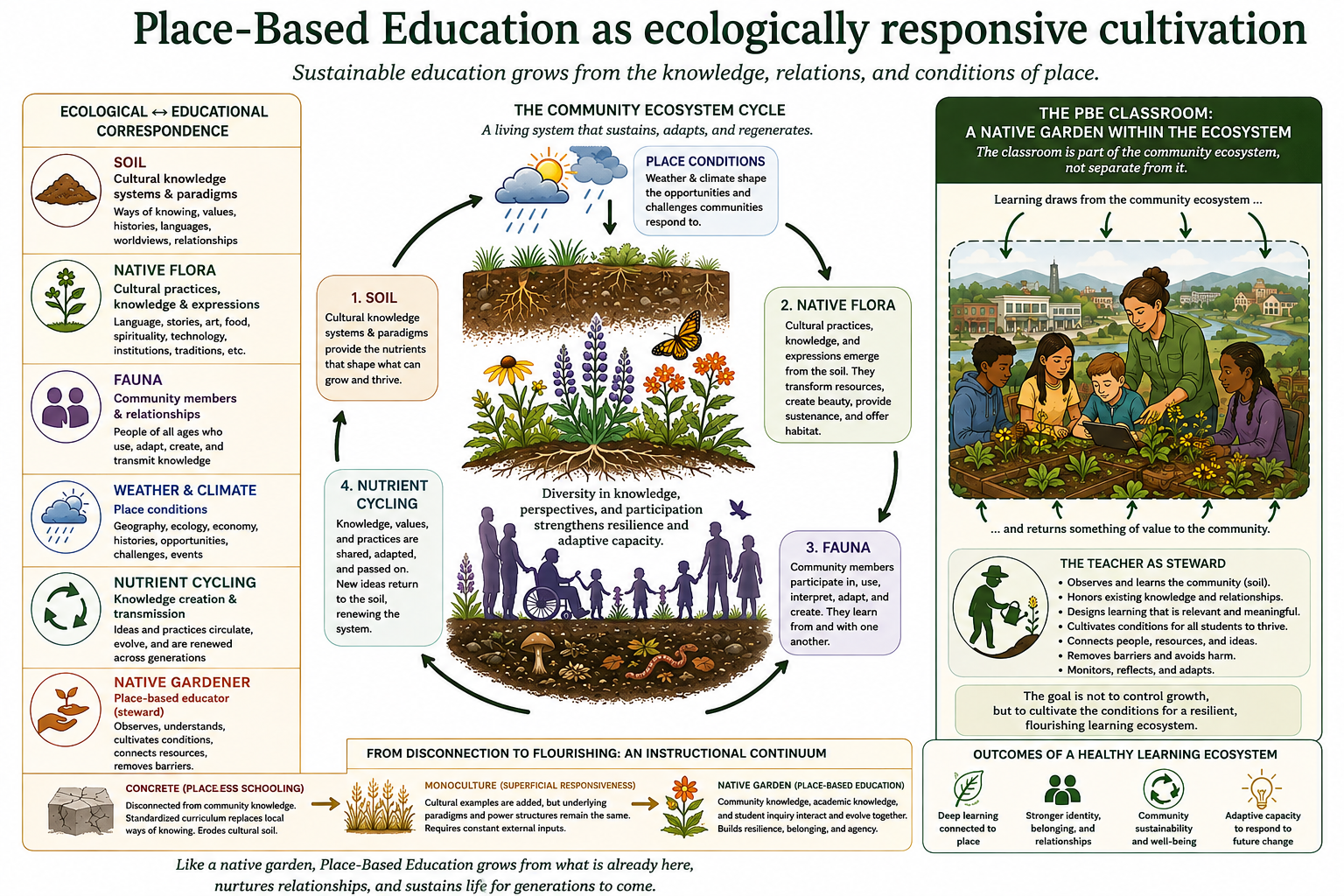
I think cultural knowledge systems and paradigms function much like soil.
Communities accumulate ways of knowing, valuing, relating, interpreting, and making meaning. These include languages, histories, epistemologies, spiritual traditions, understandings of relationships, ideas about development, relationships with land, and assumptions about what knowledge is valuable and who possesses it. We may not always see these things directly—just as we don’t see most of what is happening below the surface of a garden—but they shape what emerges above ground.
This was one of my earliest mistakes as a gardener. I was looking at the plant without understanding the soil. I wonder how often we do the same thing in education. We see students’ language, behavior, interests, family practices, or ways of participating without asking about the deeper systems of knowledge and relationships from which those visible practices emerge.
A native gardener learns the soil before deciding what to plant.
A place-based educator learns the community’s knowledge systems and paradigms before deciding what to teach.
Cultural Practices Are the Flora
If cultural knowledge systems are the soil, then cultural practices, expressions, and products are the flora. Language, food, art, stories, technology, institutions, clothing, traditions, literature, ways of solving problems–these are the flora that populate our community landscape.
Like plants, these visible expressions emerge under particular conditions. But plants don’t merely reflect the soil beneath them. They transform resources, create food, provide habitat, reproduce, interact with other organisms, and eventually return nutrients to the system.
Cultural practices do something similar; they make knowledge visible and usable. Through them, knowledge is enacted, transmitted, interpreted, and transformed.
This distinction matters for education. A culturally responsive lesson isn’t simply one that decorates an otherwise unchanged curriculum with culturally familiar examples. Cultural knowledge is not ornamental landscaping–it is part of the living system from which students make meaning.
People Are Participants in the Ecosystem
Of course, plants alone don’t make an ecosystem. Fauna consume plants, pollinate flowers, distribute seeds, modify habitats, and eventually return nutrients to the soil. They aren’t passive beneficiaries of an ecosystem; they actively reproduce and transform it.
Like fauna, people don’t merely receive culture. Community members use, interpret, adapt, create, and transmit knowledge. Through participation, cultural knowledge is continually returned to the community in renewed and sometimes changed forms. Culture, therefore, isn’t inherited unchanged, it is continuously regenerated.
This is where the ecological metaphor influences how I think about students. Students aren’t empty plots of land waiting for teachers to plant knowledge in them. Students are already participants in living knowledge systems. They bring language, experiences, relationships, histories, questions, ways of interpreting the world, and knowledge accumulated through their participation in families and communities. They also have the capacity to transform that knowledge and return something new.
Education should be like nutrient cycling. That is to say that learning shouldn’t only flow from teacher to student, it should move something like this:
- Community knowledge informs curriculum →
- Curriculum prompts student inquiry →
- Student inquiry leads to community contribution →
- Community contribution renews community knowledge. ⟲
PBE intentionally connects schooling to that cycle.
Climate Matters
My phlox also taught me that good soil and the right plant aren’t enough. Conditions matter.
Ecologically, we can distinguish between climate, the relatively persistent conditions of a place, and weather, the more immediate events organisms experience. Communities have both. A community’s “climate” includes geography, ecology, economies, demographics, institutions, political structures, and histories. Their “weather” includes immediate events and disruptions: migration, economic shocks, community conflicts, environmental events, new development, or changing access to resources.
Communities respond to both “climate” and “weather”, and yet schooling can sometimes behave as though those conditions are irrelevant—as though the same curriculum should grow equally well anywhere as long as we plant it correctly.
My phlox would like a word.
Biodiversity Is a Strength, Not an Obstacle
One of my favorite consequences of changing my gardening practices has been watching biodiversity return. The more varied the plants became, the more varied the visitors became.
Ecologically, biodiversity contributes to resilience. Different organisms occupy different niches and respond differently to environmental changes. Diversity gives an ecosystem more ways to adapt. The same possibility exists in a classroom.
Students bring different identities, languages, knowledge, perspectives, histories, experiences, and forms of participation. We often talk about this diversity as something teachers need to “accommodate.” But what if we thought about it as part of the knowledge-producing capacity of the classroom itself?
A healthy learning ecosystem doesn’t require sameness; its resilience depends partly on difference. That changes the question from “How do I teach effectively despite all this variation?” to “What becomes possible because all of this variation is here?”
From Concrete to Monoculture to a Native Garden
Thinking ecologically also gives me a way to imagine different approaches to curriculum.
At one extreme is concrete. Remove the plants, cover the ground, and you no longer have to worry very much about what the soil can sustain. In education, this resembles placeless schooling: community knowledge is largely irrelevant because knowledge comes almost exclusively from standardized curricula and disciplinary authorities. The curriculum can theoretically be placed anywhere because it was designed for nowhere in particular.
A step beyond concrete is monoculture. Here, something is growing, but we have dramatically reduced the ecosystem’s diversity. In education, I think this resembles superficial cultural responsiveness. We might add a local example, a cultural artifact, or a familiar name to a lesson, but the underlying curriculum, epistemology, and distribution of authority remain largely unchanged.
Then there is the native garden. In this model, community knowledge, disciplinary knowledge, students’ experiences, local problems, and knowledge from outside the community interact. Students aren’t simply recipients of curriculum; they become contributors to a learning ecosystem.
This doesn’t mean that everything we introduce into a classroom has to come from the local community. Native gardening has actually taught me a more nuanced question than “Is this native?” I now ask: What will this do here?
- Does it complement what is already present?
- Does it meet local needs?
- Will it crowd out existing relationships?
- Does it require constant artificial inputs to survive?
- Does it increase or reduce diversity?
Those strike me as pretty good questions for curriculum, too.
The Teacher as Gardener and Ecological Steward
All of this leads to one final consideration: the role of the teacher.
We often use gardening metaphors in education. Teachers “plant seeds.” Students “grow.” Knowledge “takes root.” But those metaphors can still position the teacher as the person responsible for producing growth.
Actual gardening has made me much more humble. The gardener doesn’t make the plant grow.
I can learn about the soil. I can choose a suitable location. I can water. I can remove barriers. I can introduce plants that contribute to the ecosystem. I can observe what happens and adapt. But I cannot make a plant grow.
My role is to cultivate the conditions under which growth is possible. That is increasingly how I think about the role of a place-based educator. The classroom is the garden, but the community is the ecosystem.
The teacher’s job isn’t to manufacture that ecosystem or extract interesting pieces of culture from it to make school more “engaging.” Instead, the teacher learns what is already there, honors existing knowledge and relationships, connects people and resources, removes barriers, introduces new resources thoughtfully, and creates opportunities for students to use both community and disciplinary knowledge to produce something meaningful.
And, just as importantly, the classroom shouldn’t simply take nutrients from the community–it should return something of value.
Sustainable Education Grows From Place
My first native gardening experiment was a bust (at least in part) because I started with the plant I wanted instead of the place where I was planting it. I had a predetermined outcome in mind: I want this plant to grow here, so I put it here. The ecosystem disagreed.
The irony is that once I stopped trying to impose my vision on the land and started paying attention to what was already there—the soil, sunlight, water, history, relationships, and existing ecology—I ended up with something far richer than the garden I originally imagined.
I got bees, butterflies, and insects I still can’t identify. And I got volunteer plants that I hadn’t even planted! I got a small ecosystem.
That experience has me wondering what could happen if we approached education the same way. What if, instead of beginning with the standardized curriculum we intend to deliver, we first learned the educational soil?
- What knowledge already exists here?
- What relationships sustain this community?
- What histories shaped this place?
- What challenges does this community face?
- What resources are already present?
- What forms of knowledge and participation might we be overlooking?
Finally: What might we cultivate here together?
PBE, understood this way, isn’t simply teaching about a place or adding local examples to an existing curriculum. It is a form of ecologically responsive cultivation. It begins by attending to what is already present rather than assuming that what has been standardized elsewhere will automatically thrive here. It recognizes that learning emerges through relationships among people, knowledge, culture, history, institutions, and the conditions of place. It seeks something more sustainable than short-term academic production: a learning ecosystem capable of adapting, contributing, and regenerating over time.
Maybe the goal of education isn’t to make every garden grow the same crop. Maybe our job is to learn the place well enough to help cultivate an ecosystem that can flourish long after we are gone.
Ready to Create Meaningful Change?
Let’s Connect.
Whether you’re interested in collaboration, consulting, or just want to start a conversation, I’d love to hear from you.
Contact Me
Related Posts

My Educational Philosphy
My educational philosophy is rooted in transformational pedagogy and humanitarian ideals. It is my belief...
0 Comments